Lead Management

Transforming the sales agent funnel at Spectrum leading to a 550k additional sales per year.
Role
Product Designer
Prototyper
Length
2024
Form
Desktop App
Mobile App
Responsive Web
Collaborators
Product, Business, Research, Content Design, Accessibility, Legal, Development

Overview

As part of the Discovery team at Charter Communications, I was part of an initiative to re-evaluate our internal sales funnel. We were able to modify and streamline the prospective customer pipeline, and project a revenue of $564,000 per year as a result.

My role as a product desiger was to conceptualize, design, and bring this product to life. I contributed in user-research, interaction design, and prototyping. After deployment, we saw an additional 550k sales for the company, which has already surpassed our initial projections.  

Opportunity

Like with many cable companies, we have a sales team that reaches out to potential customers, which we a 'prospective'. Upon discovery, we found that there was a gap in the sales funnel. Prospective customers could not be contacted after their first contact with agents, forcing them to restart the sales process every time they called the company. Abandon rates were high, and so we wanted to investigate: how can we design an experience that prevents customers from abandoning their calls?

Our goal was to develop an initiative called 'Lead Management', where sales agents can manage their leads and follow-up on prospective customers through a holistic, user-first experience.

Research

During our research, we began our discovery with a mixed-method approach, including watching recorded calls, interviews, focus groups, and workshop sessions. Our team found came to these high-level conclusions after about six weeks of research.
There was a lack of system-wide support for following up on leads.
Follow up sales calls are not approved in times of high queuing, when agents are expected to take inbound calls. Additionally, there was no formal way of saving information; agents had to write contact info and follow-up details on notepads or external note-taking platforms.
Prospects requested a call back in 78% of all abandoned calls.
Prospects wanted time to consider their options, and discuss it with family, partners, and roommates. Sometimes they had to review their financial situation. The current system demanded a 'take it or leave it' approach, resulting in a high abandonment rate.
Agents had limited time to close on a sale.
With no formal process for repeat leads, prospects may call back before the agent can make that outbound call, forcing the prospective to restart their quote process. Promotions can also expire before they can make their second contact, resulting in a loss sale.
These gaps in the process lead us to investigate deeper into both the prospective and the agent experience. We defined the pain points for our users on both sides of the process.
Prospective Customers
  • Need to repeat information every time they call in.
  • Is unable to build rapport with the agent they originally called with.
  • May miss out on an offer due to time limitations.
  • Must put in their own effort to research, take notes, and track their quotes.
Inbound Sales Agents
  • Have to ask prospectives for their (sometimes sensitive) information each time they call.
  • Loses their commission even if the prospect calls back.
  • Can't guarantee the offer again if the customer ends the call.
  •  Must build and rebuild the order in the software for each call.
After the discovery phase, our research team came to design with high-level recommendations on how to improve the experience. We needed a solution that:
- Is able to save and share information that is unique about the prospective customer.
- Builds on the rapport that agents have already established with the prospect.
- And limits repetition for information that was already captured previously.

Process

Now that we were aware of the problem space, we began to explore ideas and also gather feedback from our users. Using the Google Venture Sprint model, we began our week-long design marathon with exercises to keep ideas flowing, such as Lightning Demos (gathering ideas and examples of similar use cases), and Crazy 8's (fast, iterative sketching). After sharing our ideas and iterating on our designs, our team began to settle around the concept of a Lead Management Dashboard.
Lead Management Dashboard
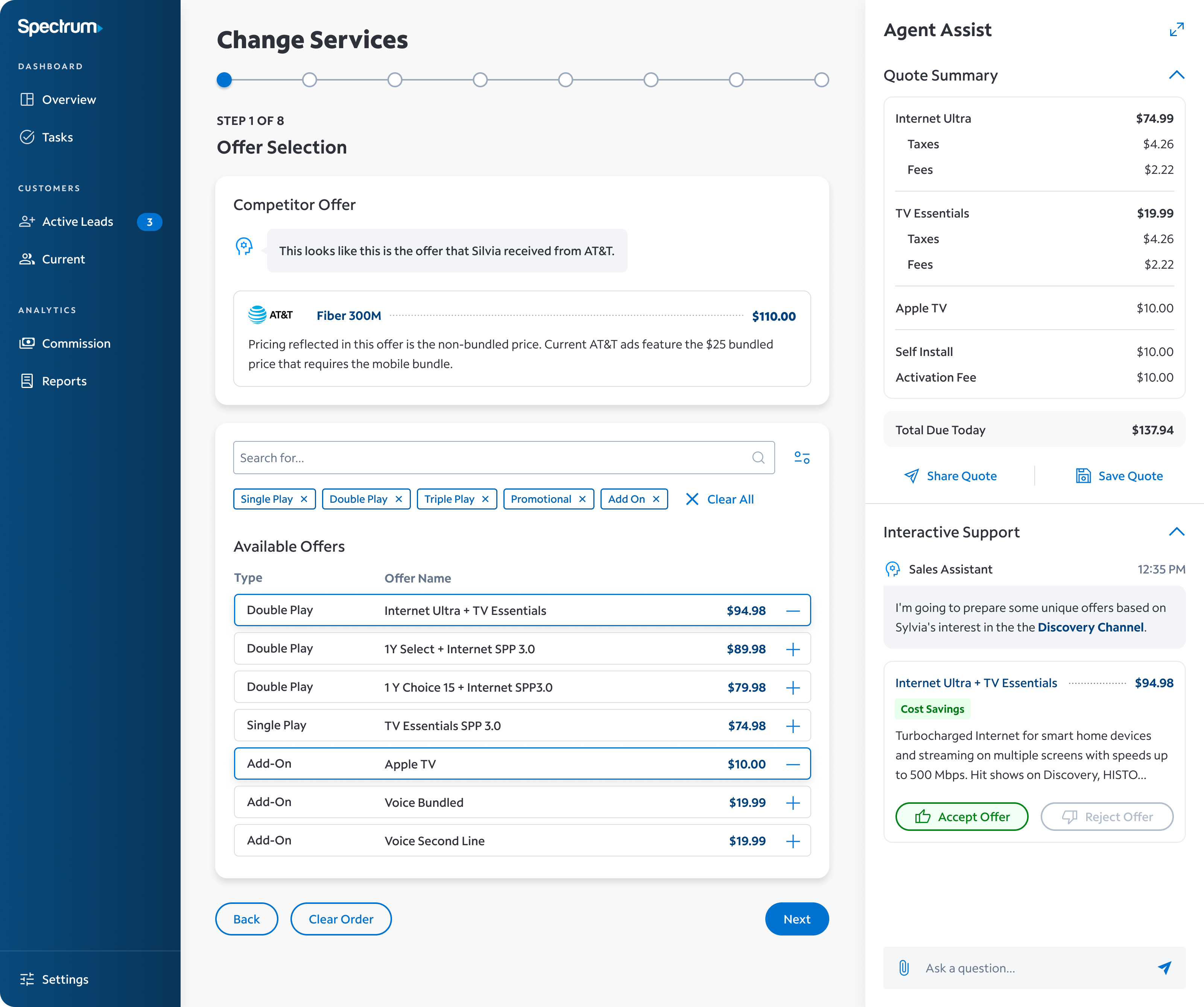
The idea around the dashboard was to give the agent all the information they needed at a glance. They could generate quotes for their leads, review competitive offers from other companies, and also track the statuses of their leads.
After brainstorming and putting our ideas down, we presented our ideas through 'dot voting', and had our stakeholders vote on the ideas they liked the most. Critically though, we found that we were actually misaligned. Our assumption was that a dashboard could be used as a tool where agents can access whenever they had a hot lead. In reality, our stakeholders held a different perspective—that this would actually disrupt the agent's workflow. A dashboard wouldn't help them close on a sale—it might even slow them down, which is the opposite of what we wanted. Fortunately, we uncovered this early in the process and we were able to iterate on our designs.

Final Design

Based on the feedback that we received through both stakeholders and also through use testing, our design team went back and iterated on the original designs. We diverged from the dashboard idea and landed on a feature that was more aligned with their process—an embedded system to track, save, and send quotes to the prospective customer during the intake call. This worked better because we realized that each customer had to be approached differently. They needed quotes that were tailored to their unique needs, and agents wouldn't be able to do that with a dashboard.
Share Quote & Follow-Up
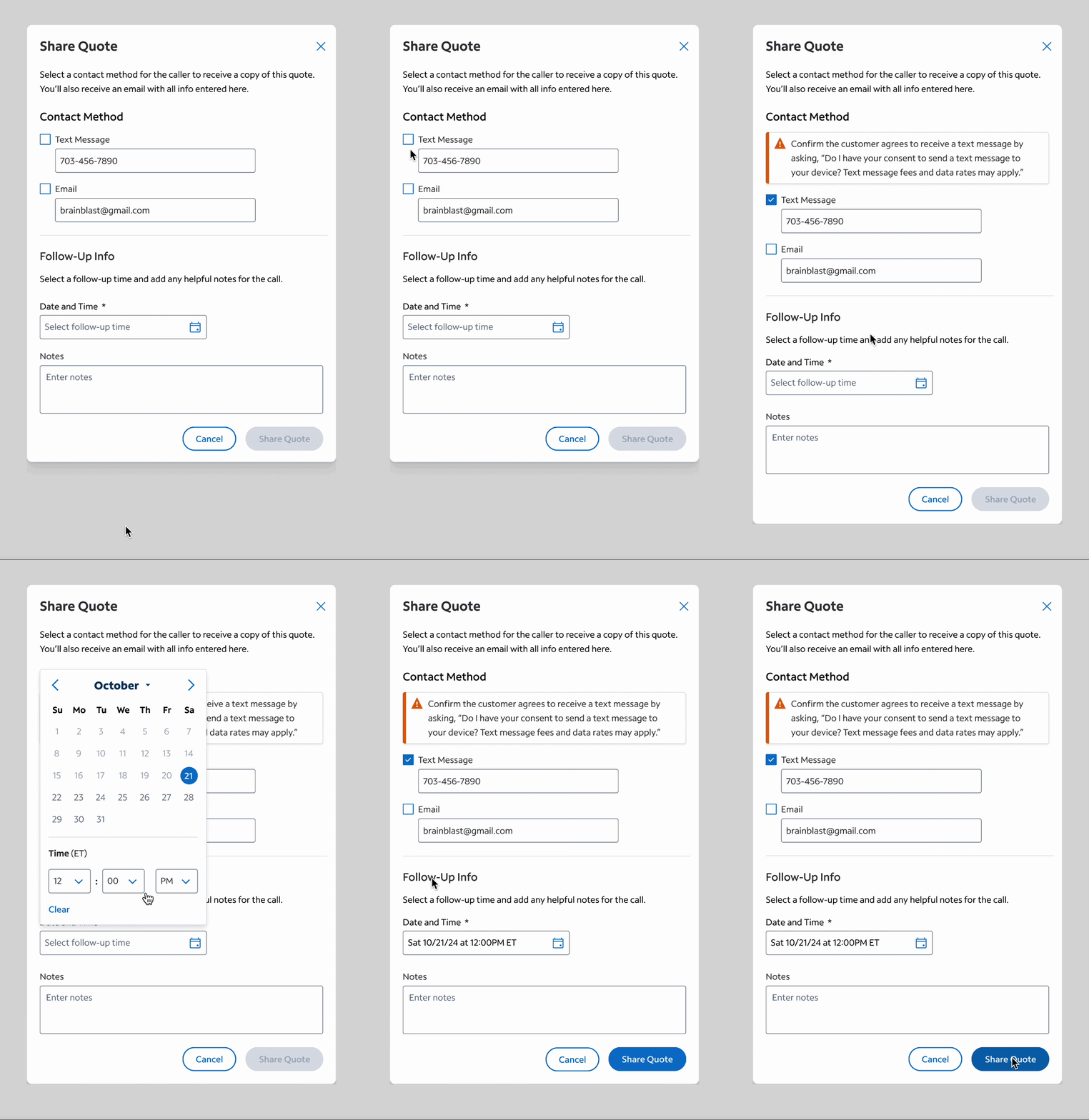
While on call, the agent is able to share quote information with the prospective customer through their preferred method of contact. The agent will also receive a copy for their own needs. And in the case that the agent needs to follow up on the call, they're also able to set a time and date, as well was additional notes. Before our team worked on this project, this feature was non-existent.
Quote Breakdown
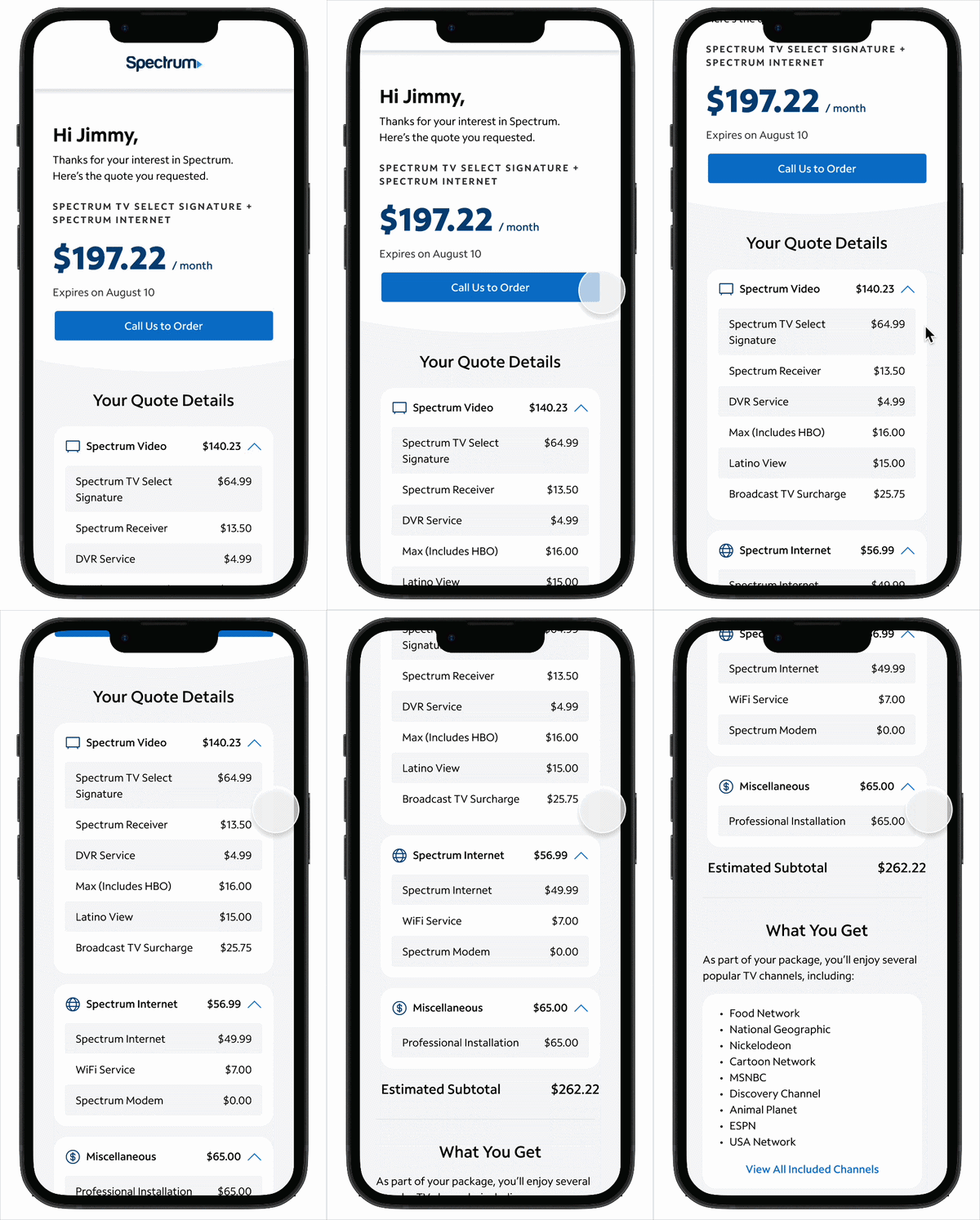
On the prospective side, agents were able to send prospects their quote offers. Prospects could see how much their quote cost, with a breakdown of their services and details. This allowed the prospect to properly review and evaluate the value of our offer instead of having to call agents to ask about their quote. This will save time for both the prospective customer and the agent.

Note: The prices and products shown are only for display purposes and are not representative of the products that Spectrum offers.
Saved Quotes
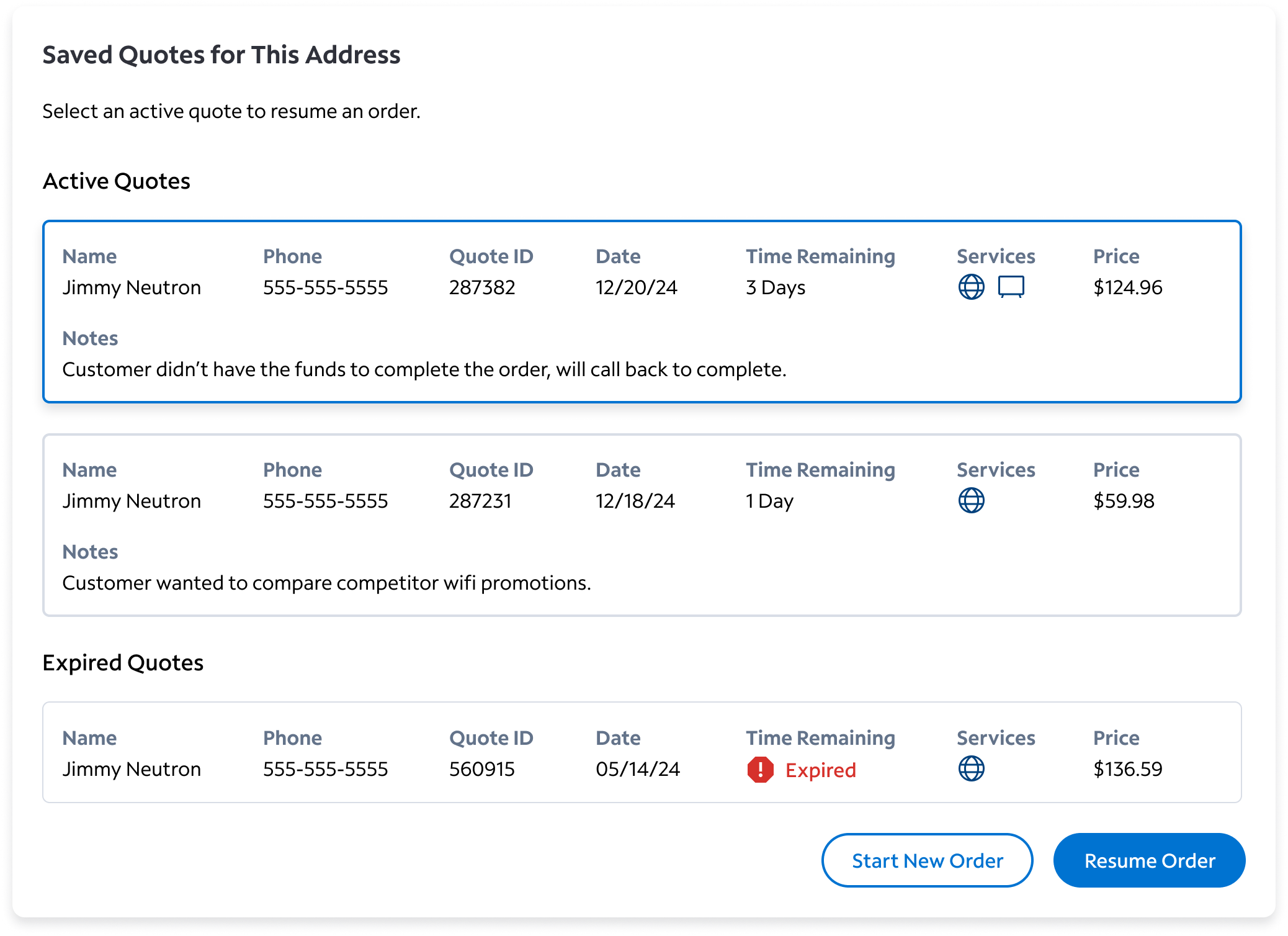
Now, when agents follow up on a call, they can also view past quotes have been saved from last time. They're able to find previous quotes that the customer had previously been given before, and they don't have to waste time rebuilding the order again, which was one the main pain points we had uncovered during discovery.

Conclusion

The design phase of this project concluded in 2024 and released to our users on March of 2026. Since then, we've seen an additional ~977k leads captured, and of those leads, about 56% were converted to a sale, resulting in an additional 550k sales for the company. This was amazing news, and has already surpassed our initial projections.

In the end, this project was an amazing success. I was reminded that sometimes the best solution is the simplest, and that not every product needs a dedicated dashboard. It's an important lesson to learn. At the end of the day, our job is to solve a problem. What our agents needed wasn't a modern, sleek dashboard, but space to do the work they do best, embedded in the flow that they were already familiar with.

Other work